Should war ever break out between the United States and China, the Chinese populace will start off with one huge advantage. No, not the population’s uncanny ability to dodge rapidly approaching projectiles, honed daily in Frogger-like pedestrian adventures; nor will it be the thick coating of particulates already insulating Chinese lungs from any potential U.S. chemical or biological agent. Rather, it’s that most Chinese folks are 100% unfazed by massive explosions everywhere around them, and, in fact, seem to rather enjoy it.
Max and I were at his friend’s apartment for Chinese New Year, in what I’m told is a relatively tranquil part of Beijing. But starting around 3PM, a low-level rolling thunder starts building in every direction, and the crescendo doesn’t peak for the next 12 hours. From the 37th floor rooftop of this building, we had an incredible 360 degree view of the whole city. But perhaps the most awesome sight of the evening was when one of our host’s friends - perhaps having imbibed too much Chivas and sweet green tea, the Chinese answer to vodka and Red Bull - inadvertently shot off roman candle charges directly at two ladies walking their dog. The charges missed by a few feet, but what was really impressive was that they didn’t even flinch... not even the dog! Hard! (Max's pictures, which establish that I was not nearly so stoic, will be shared as soon as he sends them to me).
Then you learn that Spring Festival actually lasts for about two weeks. So three days later, when you’re strolling out from a nice dumpling dinner, “BANG!” and little kids scurry everywhere like insurgents with IEDs.
But despite my personal measured ambivalence (read: uptight aversion) to fireworks/explosives, I have to confess that I really like the d.i.y. approach to the holiday. I get that the provision of certain non-rivalrous, non-excludable public goods is one of the things states are supposed to do, but there’s something really lame about celebrating one’s freedom by passive reception of government-provided spectacle. There is some irony to the fact the Chinese have a wildly more democratic approach to their blow-shit-up holiday than we do.
Monday, February 25, 2008

Top 10 Songs about D.C.
What do you do when you're on 23 hour train rides with an old friend from home? You make lists of songs about that place. So below, I give you Max West and Thomas Frampton's ten songs about, tangentially referencing, or in some other way related to Washington, DC.
10. "Lindbergh," by Woody Guthrie
Guthrie's song about the America First Committee, a cause championed by Charles Lindbergh, which sought to keep the United States out of WWII: "So I'm a gonna tell you people, if Hitler's gonna be beat / The common working people has got to take the seat / In Washington, in Washington / And I'm a gonna tell you workers, before you cash your checks / They say 'America First' but they mean 'America Next' / In Washington, in Washington."
9. "Washington, DC," by The Magnetic Fields
The song isn't really that good... It's just got the lyric: "W-A-S-H-I-N-G-T-O-N-baby-D-C."
8. "Guerrilla Radio," by Rage Against the Machine
"Contact I hijacked the frequencies / Blockin' the Beltway, move on DC"
7. "Mt. Pleasant Isn't," by The Evens
6. "Banned in DC," by Bad Brains
5. "This is DC," by DJ Eurok
"This is DC, you might think that you own it / A piece of South Africa on the Potomac..." Give it a listen: http://www.myspace.com/djeurok.
4. "Washington Bullets," by The Clash
3. "The District Sleeps Alone Tonight," The Postal Service
Probably a better ranking than it deserves, but I'm a sucker for that kinda stuff.
2. "Chocolate City," by Parliament
1. Specifically this version of "Hail to the Redskins"
Honorable Mentions: Every other Go-Go song ever; "District Night Prayer," by Q and not U; "Salvation," by Citizen Cope; "Christ for President," by Billy Bragg & Wilco; and we're pretty sure some stuff by Public Enemy.
Of Mongolians, Russians, and the Chinese...
NOTE: I get lonesome sometimes. Bonus points to anyone who posts a comment.
Maybe because it's so friggin' cold all the time - or maybe just because they're not Russian - Mongolians seem to be a really friendly people. You can't afford to be an asshole in such an unforgiving environment, I think. Another consequence of the cold (according to my new friend Rob, one of the Peace Corps kids and future anthropologist) is that Mongolians don't really open their mouths when they speak, producing this beautiful guttural language. Unfortunately, the Russians burned most of the books over the 75 years of their de facto control over the country, so the language is rather limited. (Mongolian hip-hop thus sounds kinda like M.O.P. with less-hardcore instrumentals).
I can't really do justice to how cold Ulan-Bator is this time of year (fun fact: it's the coldest capital in the world). One night I went out to get Indian food with some Peace Corps kids -who spend most of their time in one-person gurts 500km-700km outside the capital where it really gets cold - and one of them had the fantastic idea of walking back to the guesthouse. Now I can die knowing how miserable it feels to walk over a mile in -29 degree C. Then again (moment of sheepish/awkward self-awareness), that's probably the only reason one goes to Mongolia in February.
Lonely Planet describes Ulan-Bator as "a place that by no stretch of the imagination could be called beautiful," and despite the massive coal power plants billowing yellow-brown smoke on the edge of town, I found it really grew on me. Western business attire and cell phones are common now, but there are also plenty of folks walking around in fantastically colorful about-to-sack-a-Chinese-wall robes and pointy boots. Downtown features an even number of Soviet-design concrete apartments and traditional yurts. And the cars are all British-style, yet people inexplicably drive on the right. A palimpsest, if you will. It's all very confusing, in a charming sort of way.
Despite the book burning and wholesale annihilation of 1/3 the male population (including tens of thousands of Buddhist monks) Mongolians still love the Russians for one simple reason: they hate the Chinese even more. (Apologies, incidentally, for the totalizing and monolithic generalizations about races/nation-states in this blog... it comes with tourism). The Chinese and Mongolians have been going at it for, literally, a couple thousand years, most recently coming under Chinese domination during the Qing Dynasty in 1691. The tumult around the collapse of the Qings in 1911 and the October Revolution in Russia produced a period of instability in Mongolia, but by 1924 an independent (from China, anyway) Mongolian People's Republic was declared. The Mongolians are still so psyched about that that one of the top pop songs recently was an ode to Russian-Mongolian relations, and overlooking Ulan-Bator (which means"Red Hero") is a fantastic Russian mosaic paying tribute to the Unknown Mongolian Proletarian Hero. When the Soviet Union fell, the Mongolians followed right behind in transitioning to multi-party democracy and neoliberal capitalism in 1990 (though, interestingly, 99% of the country's land is still publicly owned, which probably makes sense if you're a nomad). And they put mutton, or mutton fat, or some other mutton byproduct in absolutely everything they cook, vegetarianism being, you know, a Chinese thing.
I didn't get a real good sense of the nightlife, on account of 14 Mongolians having died on New Year's after it turned out the vodka they were drinking was actually METHANOL. (This is why vodka costs 1/3 the price of an orange, apparently, and it made me glad I'm more of a plastic-bottle beer guy than a methanol-vodka drinker). Since the vodka producer put methanol not only in his company's bottles, but lots of other companies' bottles, as well, the government put a month-long prohibition on all booze for the month, on the bar scene was thus a little subdued. Just as well, more time in the unbelievably gorgeous countryside. On a side note, the Mongolian authorities quickly tied to the tainted vodka to the Chinese.
Monday, February 18, 2008
Novosibirsk is the New Brooklyn...
I had two weeks between the end of the Israel trip and the date I promised Max I'd meet him in China. My first impulse was to see if there was any way to hitch it, but unfortunately, the road between Tel Aviv and Beijing happens to pass through Baghdad, Tehran, Kabul, Islamabad, Kashmir, and a good chunk of the Himalayas. Tempted though I was by the prospect of immediate induction into the Crimethinc Hall of Fame, I eventually settled (sorry Mikey) on the cop-out, second-cheapest route: the Trans-Mongolian Railway.
The prequel to the trip, flying to Moscow on Aeroflot's discount competitor Kaliningrad Air, turned into something of an adventure in and of itself. Not wanting to arrive in suburban Moscow at 3AM in the dead of winter, I cleverly booked my ticket to include an 8-hour overnight layover in the Kaliningrad airpot. What I failed to anticipate was: 1) that the Kaliningrad airport closes in the evening, 2) that someone would forget to inform the humorless Kaliningrad military personnel that the Cold War was over, and 3) that I'd find myself sans clothes staring into the bleak, sleeting, pitch-black Kaliningrad night. This was not good. After a lot of begging and a few dollars' "change tax" - which I have good reason to suspect will not end up benefittng the good stakeholders of Kaliningrad Air - I managed a seat on the last flight out to Moscow that evening, arriving triumphantly in suburban Moscow at 3AM.
It's 6 days, 5 nights by train from Moscow to Ulan-Bator, Mongolia - 6,265km. In Moscow, I convinced this Dubliner kid named Steve to come with me, which was good since the two of us ended up being the sole non-Russian, non-Mongolian people on the train for the next 5,500km. Apparently late January isn't the peak of tourist season for Siberia. Steve affirmed all of my stereotypes about Irish people, which is to say he was incredibly amiable, was a minor drunkard, refused to pronounce the sound "th" (e.g. "tirty-tree and a tird"), and made up outrageous claims as to the exploits of various Irishmen. When you'd explain to Steve that such feats were simply mathematically impossible, he would respond in all earnestness, "No, no. Irish are hero people!"
Our best friends on the train were the party next door, the Mongolian Olympic Freestyle Wrestling Team. They were fresh from a competition in Krasnoyarsk, where apparently the squad performed quite respectably. In Nizhneudinsk, my buddy Bayaraa Naranbaatar (or "Sun Hero") bought a 5-liter plastic jug of beer to celebrate, and a good time was had by all.
The wagons on the train have nine compartments, each of which have four bunks and are about the size of a small prison cell (6'2" x 5'10" x 9'). Up above there's a cubby for blankets and whatever baggage doesn't fit beneath the bottom bunks, and there's a small table by the yellow-brown curtained window for tea or playing cards. The doors between each wagon are essentially the same heavy metal doors they use for industrial-sized freezers, and at each stop, the conductors spend 15 minutes chipping away at the ice that's accumulated on the bottom of the train since the last stop. For the first day and night we had a friendly young Russian trucker in our compartment - who successfully undermined my belief that Russians are uniformly the least adjectival hospitable people on earth - but for the vast majority of the trip, we had the cell to ourselves.
It took me a long time to realize what made the scenery seem so alien - aside from moonscapes of frozen lakes, the vast expanses of barren wilderness , and the occasional weathered, wooden houses with improbably colored shutters (yellow, bright turquoise, fuchsia, and dark blue are popular... together) - when finally I realized: there's no graffiti! It's really odd to spend so long on a train, cover so many miles, and not see the smallest piece on a passing freight train or village wall. Someone really needs to let all the hipsters back home know that Novosibirisk could, like, totally be the new Williamsburg. (It honestly felt like a relief to get to Mongolia, where there is an active hip-hop community, and see some tags again).
All in all it was a fairly easy and uneventful ride, but there were moments of terror, too. In my 24 years I feel like I've gotten myself into a respectful number of off-the-beaten-path places, and, if lucky, usually managed to get myself into trouble there. But this train ride produced probably the single most unsettlingly lonesome feeling I've ever had. It's 2AM and we pull into this little Siberian town called Zima (meaning "Winter," in Russian) where it's -20 degrees C. The stop is supposed to be for 25 minutes, and I haven't really stretched all day, so I put on all my clothes and wander outside. Through the window of a closed-down stall, you can see a healthy-sized bottle of vodka costs a third the price of one orange... seriously boondock country. And then suddenly, from a couple hundred meters away, you hear the sound of your train starting to pull away. (Luckily, it's just the engine being changed). It's the most sickeningly desperate feeling there is, and I didn't go further than 20 ft from the train the rest of the trip.
Sunday, February 10, 2008
How the Other Half Lives
So with my passport surrendered to some friendly Russians who promised they could produce a tourist visa within 36 hours for a few sheckles (I procrastinated on a thing or two before leaving the States), I decided to try and skip across to the Palestinian town Beit Sahour before my flight out the following day. An American friend from college, Jared, came over a year ago on a Birthright trip, found an apartment, and has been working there for Ma'an News Agency ever since.
It took most of the day to get my act together in Tel Aviv, hop a bus, hike through Jerusalem, and find "Damascus Gate" along the Old City. After Birthright it feels a bit taboo (and thus quite exciting) being in a part of Jerusalem where Arabs are clearly in the majority, like venturing over to the girl's side of the gymnasium during the 5th grade dance, and by now it's getting dark. But with surprisingly little trouble I manage to find my way onto the "bus" (read: minivan) to Bethlehem, pay a few sheckles, and we're off.
Along the way I'm sort of poking my head out the window, checking out the scenery, and, yeah, trying to see if I can catch a peak of this separation fence I'd been hearing so much about. Then, all of sudden after about a half hour, a 30 feet high concrete barrier appears smack across the center of the road. For a brief moment I think we're going to hit it, but the bus driver pulls a fast one, circles around, and pulls to an abrupt stop. There's a small rush to the checkpoint, everyone's trying to get home from work, but I get stuck fetching my guitar out of the back (goddamn hippie) and end up at the end of the line.
To clarify, calling the Bethlehem crossing a "checkpoint" is sorta like calling King Kong a mid-sized monkey or Dick Cheney a great marksman. For some reason when I think of checkpoints I think of barbed-wire, some soldiers, and maybe some moveable wooden sawhorses blacking the road. At worst you think of Checkpoint Charlie in Berlin, maybe. The Bethlehem crossing is more like a prison intake facility, a massive structure with bright spotlights, dozens of lines and stations to file through, and long narrow corridors with 15 foot fencing (bending in at the top) taking you from place to place. A heavily-armed kid who couldn't be more than 18 helps sort out the rabble, pushing two or three folks in at a time, telling a father he can't go in the same line as his kid. My lack of a passport turns out to be no big thing, though --- white privilege mixed with confidence triumphs again! --- and finally you emerge into a big courtyard. It's still the Israeli side of the wall, and there's a massive banner draped on it reading, in Hebrew, English, and Arabic (without the slightest hint of irony), "Peace Be Upon You (Israeli Ministry of Tourism)." Finally I pass through a little gateway, down some more fenced corridors, and find a taxi to take me on to Beit Sahour.
(Aside: there is holy stuff EVERYWHERE in this place. That dirty, abandoned lot across the way from Jared's apartment? Yeah, it's the exact spot the three shepherds were hanging out when Jesus was born).
I'm drained as hell by the time we get there, but Jared prevails on me to go catch a movie at a friend's house. Along the way he translates a lot of the graffiti. There on the side of this gas station is an incredible piece by British artist Banksy. This poster is for this political party. This one is the most recent martyr poster... went to his funeral a few months ago. Around back of the police station he shows me where one night a gorgeous mural of historical Palestinian resistance leaders just appeared. The location of the mural is a key thing here, kind of a "fuck you": the Palestinian Authority police are widely seen as, at best, an infuriatingly inept and powerless force, and, at worst, collaborators in the occupation.
The next day the taxi takes me back to the wall, but I want to walk around some first before crossing back. There's a place where there's a very obviously sealed metal gate --- sort of like a giant garage door in the wall --- and I walk by some men say in English, "It's closed." This takes me a sec: the wall is very tall, and it seems very plain that no one is getting through this door, unless perhaps they're in an Israeli tank. Finally I realize that this is a joke, I make some sort of comment about how I've never scene anything like it, which earns a nod. The first man says, "May it fall soon," I reply with, "Inshallah," which gets a few more nods, and I walk on.
Two last observations from my briefest of visits to the "other side":
1) At least around Bethlehem, it's very clear that the wall's positioning has very little do with protecting Israel proper, or even Israeli settlements in the West Bank. The nearest house on the Israeli house here isn't actually anywhere close to the wall. If you step a block or two back onto higher ground, you can see how the wall cuts across the Green Line, literally right up to people's houses, and places a 30 foot concrete barrier between them and their olive groves. Now I've never cared for olives, I find them disgusting personally, but that would piss me the hell off.
2) The graffiti is absolutely incredible. Recently a lot of European artists came down and did pieces in this area (not to universal acclaim by the locals, incidentally) but it really is a hell of a gallery. One piece consists of a couple of stencilled kids, who appear to have cracked a hole in the wall, and "through it" in bright, photo-realist style, you can see a tropical paradise scene. Another piece just consists of bold, black, 6 foot letters that read, "ICH BIN EIN BERLINER." My favorite, though, was definitely:
I spend the day making my way back to Tel Aviv, where I play a punk show that night that's a benefit for a group called Jews Against Ghettos. (How do you argue against that, really?). The band after me had a pretty impressive video display of actions in the West Bank projected behind them while they played, and someone else passed out their lyric sheet before their set. There should be a rule that all punk bands have to go back to doing that (nah, all musicians really), because if you're not saying something that some kid can back home afterwards and re-read and think about it, you shouldn't be opening your mouth in the first place. It made me realize how long it'd been since I've been in a place where punk actually felt like it might matter. The show hardly raised any money after paying for the space, but that turned out not to be that relevant. The gig was supposed to be for medical bills for a girl who'd recently been shot in the head, but that evening she died anyway.
It took most of the day to get my act together in Tel Aviv, hop a bus, hike through Jerusalem, and find "Damascus Gate" along the Old City. After Birthright it feels a bit taboo (and thus quite exciting) being in a part of Jerusalem where Arabs are clearly in the majority, like venturing over to the girl's side of the gymnasium during the 5th grade dance, and by now it's getting dark. But with surprisingly little trouble I manage to find my way onto the "bus" (read: minivan) to Bethlehem, pay a few sheckles, and we're off.
Along the way I'm sort of poking my head out the window, checking out the scenery, and, yeah, trying to see if I can catch a peak of this separation fence I'd been hearing so much about. Then, all of sudden after about a half hour, a 30 feet high concrete barrier appears smack across the center of the road. For a brief moment I think we're going to hit it, but the bus driver pulls a fast one, circles around, and pulls to an abrupt stop. There's a small rush to the checkpoint, everyone's trying to get home from work, but I get stuck fetching my guitar out of the back (goddamn hippie) and end up at the end of the line.
To clarify, calling the Bethlehem crossing a "checkpoint" is sorta like calling King Kong a mid-sized monkey or Dick Cheney a great marksman. For some reason when I think of checkpoints I think of barbed-wire, some soldiers, and maybe some moveable wooden sawhorses blacking the road. At worst you think of Checkpoint Charlie in Berlin, maybe. The Bethlehem crossing is more like a prison intake facility, a massive structure with bright spotlights, dozens of lines and stations to file through, and long narrow corridors with 15 foot fencing (bending in at the top) taking you from place to place. A heavily-armed kid who couldn't be more than 18 helps sort out the rabble, pushing two or three folks in at a time, telling a father he can't go in the same line as his kid. My lack of a passport turns out to be no big thing, though --- white privilege mixed with confidence triumphs again! --- and finally you emerge into a big courtyard. It's still the Israeli side of the wall, and there's a massive banner draped on it reading, in Hebrew, English, and Arabic (without the slightest hint of irony), "Peace Be Upon You (Israeli Ministry of Tourism)." Finally I pass through a little gateway, down some more fenced corridors, and find a taxi to take me on to Beit Sahour.
(Aside: there is holy stuff EVERYWHERE in this place. That dirty, abandoned lot across the way from Jared's apartment? Yeah, it's the exact spot the three shepherds were hanging out when Jesus was born).
I'm drained as hell by the time we get there, but Jared prevails on me to go catch a movie at a friend's house. Along the way he translates a lot of the graffiti. There on the side of this gas station is an incredible piece by British artist Banksy. This poster is for this political party. This one is the most recent martyr poster... went to his funeral a few months ago. Around back of the police station he shows me where one night a gorgeous mural of historical Palestinian resistance leaders just appeared. The location of the mural is a key thing here, kind of a "fuck you": the Palestinian Authority police are widely seen as, at best, an infuriatingly inept and powerless force, and, at worst, collaborators in the occupation.
The next day the taxi takes me back to the wall, but I want to walk around some first before crossing back. There's a place where there's a very obviously sealed metal gate --- sort of like a giant garage door in the wall --- and I walk by some men say in English, "It's closed." This takes me a sec: the wall is very tall, and it seems very plain that no one is getting through this door, unless perhaps they're in an Israeli tank. Finally I realize that this is a joke, I make some sort of comment about how I've never scene anything like it, which earns a nod. The first man says, "May it fall soon," I reply with, "Inshallah," which gets a few more nods, and I walk on.
Two last observations from my briefest of visits to the "other side":
1) At least around Bethlehem, it's very clear that the wall's positioning has very little do with protecting Israel proper, or even Israeli settlements in the West Bank. The nearest house on the Israeli house here isn't actually anywhere close to the wall. If you step a block or two back onto higher ground, you can see how the wall cuts across the Green Line, literally right up to people's houses, and places a 30 foot concrete barrier between them and their olive groves. Now I've never cared for olives, I find them disgusting personally, but that would piss me the hell off.
2) The graffiti is absolutely incredible. Recently a lot of European artists came down and did pieces in this area (not to universal acclaim by the locals, incidentally) but it really is a hell of a gallery. One piece consists of a couple of stencilled kids, who appear to have cracked a hole in the wall, and "through it" in bright, photo-realist style, you can see a tropical paradise scene. Another piece just consists of bold, black, 6 foot letters that read, "ICH BIN EIN BERLINER." My favorite, though, was definitely:

I spend the day making my way back to Tel Aviv, where I play a punk show that night that's a benefit for a group called Jews Against Ghettos. (How do you argue against that, really?). The band after me had a pretty impressive video display of actions in the West Bank projected behind them while they played, and someone else passed out their lyric sheet before their set. There should be a rule that all punk bands have to go back to doing that (nah, all musicians really), because if you're not saying something that some kid can back home afterwards and re-read and think about it, you shouldn't be opening your mouth in the first place. It made me realize how long it'd been since I've been in a place where punk actually felt like it might matter. The show hardly raised any money after paying for the space, but that turned out not to be that relevant. The gig was supposed to be for medical bills for a girl who'd recently been shot in the head, but that evening she died anyway.
Thursday, February 7, 2008
Banned in China
So, I promise I'll go back and write all about 12 hours in the West Bank, nearly dying in Kaliningrad (bonus points if you can find it on a map), the Trans-Mongolian Railway, etc., but skipping ahead real quick...
I'm now in Beijing, and it turns out that my blog - along with all of blogspot.com, wikipedia.com, bbcnews.com, and a couple million other websites - is banned in China! By some curious quirk, blogger.com (through which one updates a blogspot.com blog) isn't banned, so I can still post. Still, it's annoying, but in honor of the Party's concern for disseminating only officially-approved information, I instead share highlights from yesterday's edition of "China Daily."
I'm now in Beijing, and it turns out that my blog - along with all of blogspot.com, wikipedia.com, bbcnews.com, and a couple million other websites - is banned in China! By some curious quirk, blogger.com (through which one updates a blogspot.com blog) isn't banned, so I can still post. Still, it's annoying, but in honor of the Party's concern for disseminating only officially-approved information, I instead share highlights from yesterday's edition of "China Daily."
Unstoppable economy (Editorial)
The severe weather conditions that have descended on the central and southern regions, devastating as they are, will not have very serious effect on the nation's economic fundamentals and will not dampen the strong momentum of economic growth, the National Development and Reform Commission has said... Our sizzling economic locomotive is simply too powerful to be hindered by such an episode. Neither the floods of 1998, nor the SARS (severe acute respiratory syndrome) epidemic of 2003 could derail it. The damage wrought by the snowstorms will also pass, according to our economic authorities.
Migrants stay put in Guangdong
Questions raised over faith 'vote'
On Jan 6, the Dalai Lama compelled monks in India's Gaden Monastery to sign a pledge not to believe in the Buddhist Guardian, Gyaiqen Xudain, and expelled nine monks who refused to take the pledge...
In the 1990s, in the name of fighting against the Buddhist Guardian, the Dalai Lama started slaughtering members of the New Kadampa sect.
He incited the Tibetan Youth Congress, Tibetan Women's Federation and some other branches to forcefully dismantle statues of the Gyaiqen Xudain, and beat up people who refused to obey. Those who refused, were suppressed, and lamas and nuns were driven out of monasteries and nunneries.
Such a "public" vote is indeed blasphemy and is a mockery to democracy and freedom. Due to the Dalai Lama's religious autocratic behavior, people cannot help but think of the inquisition during the Dark Ages and the Pope's slaughter of heathens.
How can such a "Tibetan Buddhism leader" and winner of the "Nobel Peace Prize" resort to such actions?
The Briefest Respite


Monday, February 4, 2008
"My, my, my, my slow descent..."
We leave the "Bedouin camp" to see the rest of the Negev Desert. There's hiking through sandstone canyons, sunrise atop the Masada, and a moment for quiet reflection on the rim of the Great Markesh. We crawl through intricate, impossibly narrow networks of tunnels the Jews (Vietcong-like) built to fight the Roman army in the 2nd century CE. And of course we go swimming in the Dead Sea. It's hard to describe how beautiful this all is.
A brief word about the Dead Sea, though. Life is so brief that I don't want to give the impression that I regret getting to swim there; I am a richer person for having experienced salinity 30 times that of Rehoboth Beach, DE. That said, no one can convince me that the Dead Sea, as tourist destination, is anything more than a sick Israeli hidden camera TV show. The "beach" is comprised of painfully sharp ridges of crystallized salt, which tear up your feet as you gingerly wade into the water. Some fell and their backs looked like they'd been whipped. If you make it waste deep without losing your balance, you then have to contend with the merciless sting of your calves, inner thighs, and anywhere else you might have the slightest chafing (thanks to the previous day's camel ride with the Bedouin). The women who recently shaved their legs reported unknowable agony. Then, finally, should a small wave or over-enthusiastic comrade splash even a drop of water on your face, prepare to be blinded for the next 4-6 hours. And all this is before the curative properties of the noxiously sulfurous hot springs.
But returning to the narrative: most nights, before drink, we did some sort of group activity, like games or a group discussion. The ones more expressly about Judaism or Jewish history I start to really like. I've always been really into history, I've always been really into genealogy... it makes sense. Plus, I learned at the Ghetto Fighters Museum (Mom and Dad, if you had taken us to museums with names like the Ghetto Fighters Museum when we were little, I would have been so much better behaved) that I look a little like Mordechai Anielewicz, an organizer in the Jewish Fighting Organization and 24-year-old martyr of the Warsaw Ghetto Uprising.
Other nights the activities appeal to me less. Like the evening where we watch a video that one of the Israeli soldiers in the special forces wanted to share of his commando unit. I'm expecting maybe some grainy home movies of soldiers hanging around on base, like the ones I've seen of Iraq. Instead, we first watch a sleekly produced, 7-minute advertisement (in English!?) for the unit, which tells the story of a young recruit's awesome first snatch squad operation nabbing a terrorist in a West Bank cafe. Then we watch another video, again well-edited, of an actual raid on a Nablus apartment. Upbeat European techno music pulses as commandos shout for a terrified woman and child to come out of the flat. There are blasts and gunshots. The last shot if from a hovering Israeli helicopter, smoke billowing from the apartment window, and the closing title informs us: "The mission was a success. The terrorist was killed." Perhaps 14 years of Quaker has just left me to soft for this sort of military pornography, 'cause I really don't know what to say. One of the softer-spoken girls on the trip, clearly similarly put off, raises her hand, "Why was the music so happy?" Make a note to talk to her later.
Around Day 6 I start to break down. Maybe it's the constant partying, the massive sleep deprivation, ethno-religious overload... Whenever we get back on the bus I can't seem to warm up if it's cool outside, and I can't cool down if it's warm. My back and shoulders start aching. We take a long drive from down south in the Negev up to the Galilee, going straight through the length of the West Bank on Highway 90 (a "settler highway") without so much as a mention, and I'm really struggling by the time we get there.
We spend the afternoon in the Golan Heights, annexed from Syria during the Six-Days War. We start on a hill just across the 1967 border, looking down into a valley where there are a number of old kibbutzes. From here the Syrians would shell and fire rockets at the kibbutzim, making life all but intolerable. Our guide grew up on a kibbutz here. He reads a victory poem from '67, that tells of a child and mother emerging from a bomb shelter (much like the converted bomb shelter/bar we will drink at this evening). "'Does this mean the rockets are gone?' he asks / 'Yes, my child,' with tears in her eyes." The ground is still littered with landmines, and the barbed wire fence only sometimes keeps the cattle from staying into the uncleared areas. It's cooler here, and that's when the shakes start.
A game where the Americans are made to break into three groups, and the Israeli soldiers read us scenarios. 1) A terrorist is firing rockets from a school. What should we do? (A: We tracked them with an unmanned aircraft until they came out, then killed them... No mention of cutting off power to 1.5 million residents in Gaza). 2) A woman comes to the Israeli border with no papers, like an undocumented Mexican at Juarez, claiming to be pregnant. What should we do? (A: Well, of course, we couldn't let her in. And then Israel got a lot of bad press when she had a child at the checkpoint). 3) A shepherd sees a group of Israeli commandos, and there's no way to detain him. If they left him go, he might go run and tell, thus compromising the mission. Do we kill him? (A: Jewish fighters faced such a situation in 1948. They let him go, and then 12 Jews were massacred).
The next day it's the Lebanese border. The group talks to a woman who refused to leave her family home when the war broke out in 2006, despite the hail of rockets. But I'm too weak to get off the bus, and the muscles in my back start to hurt from shaking so hard. Shlomo, our armed guard/medic (who, despite being an absolutely wonderful guy, is dubiously qualified for both his jobs) notes that my temperature has reached 39.9 C, which of course means nothing to me. I fall asleep collapse when we get back to the kibbutz for dinner, sleeping for the next 14 hours.
That night I'm back at the Western Wall. There's yelling and chasing, though I can't make out why exactly. I'm there, too, and for some reason everything is calmer right around me. At some point Shlomo comes in to check the fever, and I grow convinced I've been poisoned, that he's trying to kill me. This time I pray at the Wall, and unlike a week before, it feels right. It's the funniest thing how natural it feels. All of this starts to make sense, inexplicably clear sense. I hear more yelling, real this time, either the sound of incoming katyusha rockets or significant others back home being dropped. And then I'm standing on the white graves of the Mount of Olives, sweating and trembling violently.
When I wake the fever's broke, though vicious stomach cramps have taken its place. As we head to Tel Aviv I'm still pretty out of it, and despite trying I can't rouse myself for the last night of partying on the beach looking out over the Mediterranean. I've got nothing left. I make them take me to an Emergency Clinic while I still have 4 hours of Birthright medical insurance left, and wave goodbye, spent, when the bus leaves for the airport.
Wednesday, January 30, 2008
Desolation in the Negev
"A desolation that not even imagination can grace with pomp of life and action." - Mark Twain, on the Negev Desert, 1867
After a few days, we drive south down to the Negev Desert to spend an evening in a Bedouin tent, our first (and only) official encounter with an Arab Israeli during the 10-day program. This is something of a sensitive topic: Arabs comprise 1.3 million (or 19%) of Israel's 6.6 million population, and that percentage is growing fast. (This does not include the 3.1 million Palestinians living in the West Bank and Gaza). In 2005, Benjamin Netanyahu called "Israeli Arabs who remain... Israeli citizens" a "demographic problem" - others have used the more incendiary term "demographic bomb" - and warned that if Arabs reached 35% "than the Jewish state will be annulled." For more on the status of non-Jewish Israelis, this is a decent place to start.
I'm excited for the trip. The scenery along the way is simply staggering - within 25 minutes you transition from the lush, rolling hills of "Israeli Tuscany" to complete, rocky desert desolation - and the rustic setting is a welcome alternative to the Jerusalem bar scene. It's late, dark, and bitter cold by the time we roll into the camp - which essentially consists of a small corral for camels and six massive rectangular tents - and we're quickly brought a delicious meal as we sit cross-legged on the ground. After dinner we settle into our tents (there are quite a few different Birthright trips there at the time, and each group of 45-50 kids piles into its respective tent), and soon shuffle off to the "hospitality tent" to be formally received.
Reclining on a mat, sipping tea and playing a wonderfully twangy stringed instrument, is an undeniable, honest-to-God Bedouin. I stress this because I'm pretty certain the raggedly-dressed kids that served us dinner were Bedouin, too, but nothing distinguished them as such (for example, this guy's impressive drum and red-and-white checkered keffiyeh), and it's clear that now is our appointed Bedouin-meeting time. He welcomes us with tea and coffee, introduces himself in heavily accented English as Saleem (after some words in Hebrew to our guide), and we all settle down onto the mats for our 20-minute cultural talk. The prefatory comments are promising, introducing the fact that many traditionally-nomadic Bedouins are beginning to settle down, and how contemporary Bedouin culture represents a mix of traditional and modern culture.
And then things begin to get horribly, bewilderingly weird. "We have four wives! Yes, wonderful! I only have two wives, though." There are some gasps, some nervous laughs. "One wife is skinny, one wife is not so skinny." And then he goes on about how having many wives can create problems because of the multiple tents they necessitate; and how big trouble if two wives in one tent; and how great it is to be with skinny wife on Monday, and not so skinny wife on Tuesday; and the number of camels in dowry it would cost him to procure another. The presentation briefly leaves the topic of multiple-marriage to include Saleem's recollections of riding his camel to school, but I'm not really focusing at this point. At the end, a young woman in our group volunteers to try playing the drum Saleem has brought, and he's delighted at her effort: "Very good! I make you wife number three... Five camel dowry!"
There's a brief discussion back in our tent. Some complain that the presentation we just witnessed was offensive to women, but our trip leader is quick to help them move past such a naive, knee-jerk reaction. "Look, that's just their culture, okay? You can't say 'right' or 'wrong'... It's inappropriate of us to tell the Bedouins what they should or shouldn't do, because that's the way their culture is." The discussion doesn't last long, though, because seven beautiful, young Israeli soldiers have been assigned to our trip for the next few days, and tonight is our night to meet them. We play get-to-know you games for an hour and a half. One of the girls is a calisthenics instructor in the Army; one of the boys is part of an elite commando squad that kills terrorists.
The next morning I spot Saleem at the other side of the breakfast tent sipping coffee. His accent is noticeably milder. Saleem's been doing this gig as seasonal work for about a decade, he tells me, and before that he was a truck driver. Like most Bedouin, he doesn't actually have multiple wives. The "camp" is owned by a Jewish businessman from Jerusalem. His boss. He says what he's supposed to.
---
I want to make sure I'm as clear as possible on this. I, too, thought Saleem's presentation was offensive. Polygamy does still exists in a minority of Bedouin communities (Bedouins are a very tiny minority compared to the much larger Palestinian Arab population, it's probably worth mentioning), and there are many important Bedouin women's NGO's dealing specifically with this issue. (This might be a good place to start if you're interested in some of these groups , and if you're interested an overview of Bedouin culture that goes beyond polygamy - perhaps, for example, the Israeli government's systematic violation of Bedouins' human rights - this is a decent report).
But my anger at the presentation arises mainly for other reasons. Birthright trips are vetted incredibly closely - two independent evaluators shadowed us at different times during the program - and I simply can't believe it was an accident, an organizational oversight, that our sole official encounter with an Israeli Arab happened to be a complete minstrel show. One can argue over whether the Israeli formulation of "Jewish and democratic" is or is not an inherently racist precept, but Birthright's effective erasure of 20% of the citizenry (whose tax dollars, incidentally, funded 30% of my free trip to Israel) unquestionably crosses that threshold. It represents a form of what Amos Oz refers to as "moral autism," the willingness to assign to others a status that one would never accept for themselves. (Thanks for the book, Mom. Really good). Related to this is Judaism's encounter over the past few centuries with European humanism, particularly its liberal and socialist strains, and Oz goes on to write (critically) about the willingness of some in Israel to consign this rendezvous to the dustbins of history. In the long run, this latter tendency will do more harm to both Israel and Judaism than any suicide bomber.
Thursday, January 24, 2008
Three Pictures of the Western Wall
A good friend, who for the sake of his blog's anonymity shall remain nameless, sent me an email asking about t-shirts in Israel. And, since the last post involved the Western Wall, I wanted to add this little coda.
 Now, this relates to t-shirts, postcards, and posters because of the image below. It's of a young Israeli paratrooper on Day 3 of the Six-Day War (1967), right after the liberation/occupation of Jerusalem, and it's one of the most iconic images in Israel today. If you're able to put aside politics for a moment, it's hard not to see it as incredibly stirring. The heroic angle and composition, the expression of complete awe and wonderment before God and State at these kids' accomplishment... It was the first time in 19 years that Jews had prayed at the Wall, and probably the first time in 2000 years that it was under Jewish control. The paratroopers became national heroes, and it's no accident that the swearing-in ceremonies for the paratroopers now happen on that plaza. Those that know me might find it hard to believe, but I really love this picture, and I seriously almost bought a postcard.
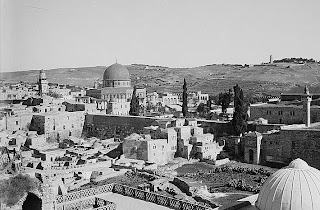
 So when I went to visit my friend Jared in the West Bank, his roommate referenced what used to be on Western Wall plaza before it was a plaza. I didn't get a chance to look it up until I got to Moscow (spoiler alert: I survive Birthright), but it turns out there used to be a Morrocan Quarter in the Old City of Jerusalem, below. It was an 800 year old neighborhood, and it went all the way up to within 10 feet of the Western Wall. On June 10, 1967, three days after taking the Old City, Israeli soldiers began demolishing the "slum area" around the wall, giving the 650 inhabitants a few hours notice to leave.
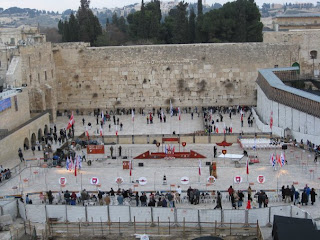
For those not in the know, a brief history lesson. The Western Wall, or the Wailing Wall, or the Kotel, is most of what remains from the Second Temple (516 BCE - 70 CE). Probably the most sacred site in Judaism, the Western Wall has been a focus of longing and prayer since it was destroyed by the Romans nearly 2000 years ago. I mentioned that we visited it our first and second day in Israel. Here's a picture, complete with the induction stand for the paratroopers on the plaza.

 Now, this relates to t-shirts, postcards, and posters because of the image below. It's of a young Israeli paratrooper on Day 3 of the Six-Day War (1967), right after the liberation/occupation of Jerusalem, and it's one of the most iconic images in Israel today. If you're able to put aside politics for a moment, it's hard not to see it as incredibly stirring. The heroic angle and composition, the expression of complete awe and wonderment before God and State at these kids' accomplishment... It was the first time in 19 years that Jews had prayed at the Wall, and probably the first time in 2000 years that it was under Jewish control. The paratroopers became national heroes, and it's no accident that the swearing-in ceremonies for the paratroopers now happen on that plaza. Those that know me might find it hard to believe, but I really love this picture, and I seriously almost bought a postcard.
 So when I went to visit my friend Jared in the West Bank, his roommate referenced what used to be on Western Wall plaza before it was a plaza. I didn't get a chance to look it up until I got to Moscow (spoiler alert: I survive Birthright), but it turns out there used to be a Morrocan Quarter in the Old City of Jerusalem, below. It was an 800 year old neighborhood, and it went all the way up to within 10 feet of the Western Wall. On June 10, 1967, three days after taking the Old City, Israeli soldiers began demolishing the "slum area" around the wall, giving the 650 inhabitants a few hours notice to leave.
With Apologies to Hunter S.
In the lead-up to the most recent Iraq War, President Bush announced a plan to use a program of "shock and awe” to cripple the Iraqi will to resist. The term comes from a military strategy paper published by the Command and Control Research Program (CCRP) in 1996
...so overload an adversary's perceptions and understanding of events that the enemy would be incapable of resistance at the tactical and strategic levels… To achieve this outcome, Rapid Dominance must control the operational environment and through that dominance, control what the adversary perceives, understands, and knows, as well as control or regulate what is not perceived, understood or known.
Naomi Klein also deals with the concept of "shock" in her latest book
Which is all by way of introducing the fact that it’s 7AM Saturday morning, I’m lying in bed spent and fighting back the vomit, waiting for the shower to free up. Then I’m gasping as the cold water hits, trying unsuccessfully to put together the past 48 hours of guns, alcohol, religion, sex and graves since we landed in Tel Aviv, and, yeah, it all feels like a bit of a shock.
Our flight to Israel is delayed 12 hours (due, we are told, to President Bush’s need to clear the airspace for his own arrival), so our group of 36 starts bonding over mini-bottles of wine and overpriced airport Heineken. Thus, I find myself not entirely on my toes for the slightly terrifying security interrogation during check-in: You never learned Hebrew? What was the last Jewish holiday you celebrated with your family, ‘Thomas Ward Frampton’? Really? And what do you call the piece of matzoh that gets hidden? Apparently I did better than the poor girls that got taken into the side-room. (On the Israeli side, though, we go through customs like it’s nothing. I guess Birthright’s got what they call “suction” on The Wire).
On the plane I sit next to an ultraorthodox rabbi, David. Actually, I sit next to a very attractive young woman, but David compels her to switch seats with him because he can’t sit next to the woman he’s been seated with. There’s a brief moment when I think David and a posse of other ultraorthodox guys are about to blow up the plane when they simultaneously break for the cockpit, but someone explains to me that they’re just putting together a minyan for prayer. But we end up hitting it off pretty well, all things considered, and he invites me to his place for shabbat after the trip.
We arrive at the hotel in Jerusalem in the very early morning. It occurs to me that despite spending the past 18 months working every day in hotels with UNITE-HERE, this will be the first time I’ve stayed as a hotel guest since I started union organizing. I pick up a towel and drop in on the ground, just because I can. Odd that hanging out in a guest room without worrying a boss is going to swing by feels like just as much a culture shock as, you know, being in Israel. (The room attendants, bussers, and bartenders at our hotel, incidentally, are all Israeli Arabs. The room attendants work on piecemeal – about $2.50 for a checkout room, less for an occupied one – which doesn’t compare too favorably to the $107.20 per sixteen-room-day that union room attendants currently make in Chicago, particularly given that the cost of living isn’t too much lower in Israel).
After a few hours of napping we’re taken to an overlook of Jerusalem. The vista is really staggering: the walls of the Old City, the Dome of the Rock, the gravestones along the Mount of Olives. We drink wine, read from Genesis, and are welcomed home. “This is not a tour, it’s a pilgrimage... this is your birthright.” To the east there’s another wall in the distance cutting across the hilltops, one that kind of gives lie to the posters around town promoting “40 Years of a Reunited Jerusalem,” but we don’t really dwell on it.
Then to the Jewish Quarter of the Old City for a few hours of tour. Again, fantastic. It so happens, though, that they’re inducting a new crop of paratroopers into the army at the base of the Western Wall that evening, so there are hundreds upon hundreds of 18-year-olds running around with guns. During lunch we’re told not to allowed past the border to the Muslim Quarter, that it’s not safe. Of course, I wander off and try and check out the Muslim Quarter, but I end up somehow getting lost in the Church of the Holy Sepulcher (which I gather is part of the Christian Quarter).
Back to the hotel where we have a professional lecturer come in to deliver a presentation on the contemporary political situation. I don’t know what to say. The guy who delivered the lecture was fucking charming (British accents, tons of jokes, owned the room), and he’s so likable you almost don’t realize that the chat he’s giving is peppered with video of incoming Katyusha rockets and anecdotes about murdered friends, with no reference to settlements, cluster bombs, or collective punishment. Even the typically aloof 18-year-old girls with the “Rich Bitch” t-shirts seem engaged. He’s really, really good.
After dinner we go out to an Israeli club (conspicuously lacking in Israelis), where there’s a disastrous amount of drinking. It’s like summer camp with an open bar. All sorts of decadence and depravity transpire that, for the sake of propriety, I’m going to have to leave inferred. I think I end up in a pitch-black room in the basement of the hotel, though that may have been another night. We’re up in a few hours to do it again.
The second day continues much like the first, with an already-depleted crew staggering around Mount Herzl (where early Zionists, most important Israeli politicians, and military casualties are buried). It’s really more of a park than a cemetery, and I really like the beautiful tree-lined winding through hilly gravesites. Way nicer than Arlington National Cemetery. “These are kids your age, just like you, who died for Israel. This one here, with the Phillies helmet at the foot, he’s an American who volunteered to fight in Lebanon, to stop the rockets. This is Yitzhak Rabin. This one is my friend Roei, another tour guide who died when his tank was hit. He could have been a medic when he was called back up, but he wanted to drive the tank. Sometimes we have to fight for peace.”
In the evening we get dressed up in our Friday best. We load into the bus back to the Jewish Quarter, and as the sun goes down we enter the completely packed plaza of the Western Wall. There are thousands of worshippers – mostly ultraorthodox in either wide-brimmed or tall, furry black hats– bowing, crying, chanting, singing, shouting. There are also a lot of 18-year-olds with guns, even if the paratroopers are gone. Unlike what you might get at synagogue on Friday night, there isn’t any one shabbat prayer service: everyone pretty much does there own thing, with different leaders setting up their own tables and others crowding around. It’s really one of the most remarkable things I’ve ever seen. I wander around, overwhelmed by it all, trying to figure out if I find religious fervor more impressive or disquieting. I think about writing a prayer and sticking it in the cracks of the stone, but it doesn’t feel right at all.
Afterwards we walk back as a group to the hotel. Jerusalem largely shuts down once shabbat comes in, and driving is prohibited for the religious. Back at the hotel there’s more sex and alcohol, and even a couple hours sleep. This isn’t a tour, it’s a pilgrimage... this is our birthright.
Saturday, January 5, 2008
A Brief Introduction...
It would be nice to have some unifying theme to this blog - a "project," right - but I'm afraid I just can't muster the forethought that would require. So it'll be a notebook, of travel, but not a friggin' travel blog/zine.
I'm hopping on the Chinatown bus in a couple hours for NYC, the first little leg of what should be a 25,000 mile trip. Something awesome (read: terrible) always happens on the Chinatown bus.
I'm hopping on the Chinatown bus in a couple hours for NYC, the first little leg of what should be a 25,000 mile trip. Something awesome (read: terrible) always happens on the Chinatown bus.
Subscribe to:
Posts (Atom)